Community
Nature Notes
HEYSHOTT NATURE NOTES
Editor – Nick Sherwin
October 2026
Keen readers of this column with good memories might recall an article from 4 years ago on the topic of Bee-flies, which speculated on whether Eric Idle had them in mind when penning ‘Eric the Half a Bee’ for Monty Python’s Flying Circus. The new kid on the block, a yet more unlikely candidate for Eric, is the Beewolf, more prosaically known as the ‘Bee-killer’.
As its name implies, the Bee-wolf is also neither a bee nor half a bee, but is a predator of bees (particularly honey bees). 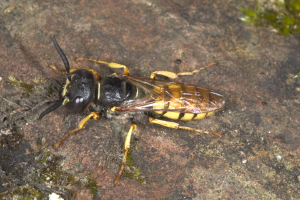 It is in fact a wasp. 20 years ago it was virtually unknown in the UK. Since then, its range has expanded dramatically stretching north and west from the south-east of England. It used to be thought that the species was single brooded, but now 3 broods a year between July and September are commonplace. The food sources for the adult Bee-wolf include heather, hemp agrimony and ragwort, so it can be found throughout Heyshott on heathland, chalk grassland or in our village fields.
The Bee-wolf is a stinger, carefully positioning itself in attack to ensure that it is protected from any defensive sting of its prey. The hapless bee will then be carried off, paralysed, to a long burrow where it will be deposited to be eaten in due course by the carnivorous larvae emerging from the egg laid by the Bee-wolf. It is curious that the public is often advised to look out for and report sightings of Asian hornets, which are considered to be a serious threat to honey been populations, yet no such threat appears to be perceived from the expanding number of the so called Bee-killers. The Bee-wolf is a solitary wasp, and the prediations of individuals may come under the radar when compared with the frantic communal activity of a hornet’s nest. But for the moment there does appear to be no significant threat to bee colonies and one should perhaps simply observe and admire the success of an apex predator, albeit one sitting on top oa a relatively small food chain.
September 2026
In Heyshott, our Collared Doves seem somewhat enigmatic. It would seem that we have fewer pairs than there are in adjoining villages, yet when a pair moves into a garden (attracted perhaps by a particular feature, such as a water source in times of little rain), their presence is dramatic. For they are feisty birds, able and willing to chase off bigger birds, such as Wood pigeons or Magpies, from their nest site. They may hesitate to tackle a colony of Rooks, but neither are they fazed by their presence. And of course, archetypal dove as they are, they mate for life and the male and female stay close to each other, apparently sharing duties both offensive and defensive.
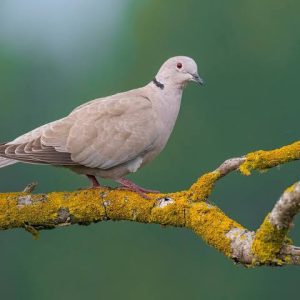 The standard description of the Collared Dove is ‘non-migratory but strongly dispersive’. This is a considerable understatement, for the species may be the most ‘dispersive’ of any bird species. Prior to the 1930s, the Collared Dove would have been regarded as an Asian species, rarely seen east of the Balkans. Over the next 20 years it colonised most of Western Europe and it reached Norfolk in the mid 1950s. By 1958, it was breeding in Sussex and it is now a common breeding bird throughout England and Wales and most of southern Scotland.
A similar dispersal has been seen in North America. If one sees a Collared Dove in certain islands of the Bahamas, one might be told by a local that it is a Bajan dove, indicating that it reached theBahamas from Barbados where it is thought some birds were released. Similarly, on Guadeloupe it is thought that some doves were accidentally released and then spread to other islands in the Antilles. In the USA however the story is different – it is alleged that some birds were released in the Bahamas in the 1970s from a pet shop after a burglary, and that these spread first into Florida and then across America as far as Alaska. Curiously however, the species has not established itself in New England, causing some to think that dispersals have been caused by a genetic mutation leading to a westerly bias. Most peculiar, one might think.
The inevitable question which arises from such a strong colonisation is whether there is any adverse effect on other species which might be regarded as more ‘native’. Intriguingly, after 70 years of their presence in the UK, there is little evidence of this. There may perhaps be 30,000 pairs of Collared Doves in Sussex, little more than a quarter of the Sussex population of Woodpigeons, and indications are that the population may now be reducing. In the US, many describe the species as ‘invasive’ and cite anecdotes of detriment to native Mourning Doves, but evidence to this effect is hard to find. The likelihood may be that the species success, aided by its wide diet and ability to breed year round, is that is that it can and does fill a niche which is made available to it. One might wonder whether an attractive new species of dove might have received a better welcome in the USA,a country in which over 10 million Passenger Pigeons – a species which co-existed with the Mourning Dove – were extirpated. No doubt there will be similar debates 70 years after the first Ringnecked Parakeets breed in the South Downs.
August 2026
It was noted in this column last year that 119 species of spider were identified in a recent survey of the Murray Downland Trust reserves. Of these species, only a small number produce webs to catch prey. These webs vary from species to species, ranging from the familiar orb webs of our Garden Spiders, the funnel or tube webs of our House Spiders, the tangled webs of our Cellar Spiders and the sheet webs, only revealed fully in Autumnal frosty or misty mornings, of our tiny eight-eyed Money Spiders.
There is one species of spider however which makes a nest for purposes other than catching prey. This is our Nurseryweb Spider, which spins a structure commonly known as a Tent. As the common name of this spider indicates, the Tent is spun in order to protect the hatching spiderlings within the ‘nursery’. The female spider carries a large white egg-sac underneath her which she deposits in due course on low vegetation, covered by the protective tent. She will then guard the egg-sac until hatching and the spiderlings after they have hatched. And so, where a Tent is spotted, the mother spider can usually be spotted close by, as shown in the photograph (courtesy Andrew Ferrier).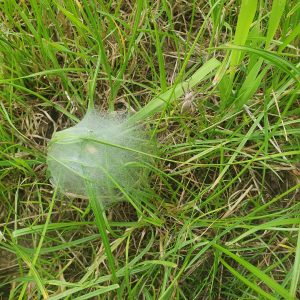
Not only does the Nurseryweb Spider have this unique strategy of protecting its young, it is also the only species of spider in the UK where the male spider is known to present a gift of wrapped up prey to the female before mating. In tropical spiders this behaviour is frequently observed as a sensible stratagem to minimise the risk of the smaller male spider being eaten by the female after mating. This may also be so in our Nurseryweb Spiders, although here there is no discernible size differential between the male and the female. Although there is only one species of Nurseryweb Spider in the UK, it is a common spider in the south of England and its Tents may be found in our gardens and in the wider grassland of our village. This is not to say however that all such spiders look the same. There is a wide colour variation rangingthrough the browns and greys. However, there is one uniform feature, visible in the photograph, which is the thin white/yellowish midline running through the top of the carapace situated between the spider’s eyes and its abdomen.
The Tents of our Nurseryweb Spiders are most prevalent in June, which was when this photograph was taken. But they can be found as late as September,so close inspections are still worthwhile. One might be tempted, on seeing a number of spiderlings, to recall the collective noun, which is a Cluster ofSpiders. It is thought however that this collective noun owes more to appearance of the spiderlings of our Garden Spiders, which can be seen clustering together in a large ball until they disperse on a single silken thread, parachute style.
July 2026
A great advantage of having Orchids as the focus of a nature walk to accompany the traditional Heyshott village cream teas is that our Orchidsstay still when approached. In consequence, an unexpected 50% increase in take up for the walks this year did not diminish the experience, and our knowledgeable visitors took great care not to damage those Orchids which were showing.
The timing of the walk in early June coincides with the greatest number of species which are flowering at the same time. This does mean however that our walkers missed several species. The Early-purple Orchids and Green-winged Orchids were ‘over’, and so too the striking White Helleborines, though some seed spikes of these were seen remaining under Beech trees on the Scarp. Other species, notably our rare Musk Orchids, had not yet emerged.
Now is the time to search for these short plain green flowered spikes above the chalk heart on the Scarp; their rarity may compensate for the view, expressed with poor grace in a different context in television commentary in this Wimbledon season, that they may not be ‘much of a looker’.
The weeks of drought this Spring and Summer has had an effect on our Orchids. For once, the substantial spikes of Common Twayblade, with their eponymous large double leaves below, were relatively scarce. Nevertheless, there were good numbers of Common Spotted-orchids gracing the landscape alongside the newly emerged Pyramidal Orchids. Southern Marsh-orchids were prominent in a Heyshott garden and splendid specimens were found of Greater-butterfly and of Bee Orchids.
Perhaps the highlight of the walk was the one Fly Orchid spike (photo courtesy Jonathan Mycock) standing proud in splendid isolation on the right hand side of Chalky. 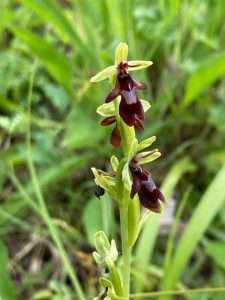 The Fly Orchid is so named because its flowers resemble flies, although the received wisdom – supported by a splendid photograph taken in Wiltshire in the 1980s of a wasp endeavouring to mate with a flower – is that Fly Orchids are in fact pollinated not by flies but by two species of Digger Wasps (wasps, that is, which paralyse their insect prey and store them in nests as food for their larvae). It is nowadays thought that the Bee Orchids native to the UK are self pollinating, notwithstanding the resemblance of their flowers to solitary bees and the pheromones released by the Orchids to attract them. Perhaps Fly Orchids, like Bee Orchids, hedge their bets – theyare able to self pollinate but, where suitable insects are present, these resources can be tapped to cross pollinate the species and increase genetic diversity. Our solitary spike has little choice in the matter even if Digger Wasps are present and sufficiently gullible.
June 2026
The dictionary definition of an Umbellifer is unhelpfully that of a plant whose flowers are arranged in ‘umbels’; only slightly more helpful is the dictionary definition of an ‘Umbel’, viz a flower cluster where several short flower stalks spread from a single point. None of this is really needed : the key is that the term was devised by 16th century botanists and was derived from the Latin for parasol, signifying to us that the flower cluster looks like an umbrella.
Unlike one’s traditional umbrella however, our Umbellifers’ flowers are generally white. During May and June, our roadside verges in Heyshott are full of Umbellifers. The most well known is Cow Parsley, which is perhaps the easiest to identify, for it comes out as early as April when there are no similar species to cause confusion. The stems grow to a height of 3 feet, the umbels spread across to a length of approximately 6 cm and the leaves branch out below the umbels with two or three opposite pairs of delicate leaflets lying below the single leaflet at the stalk’s end.
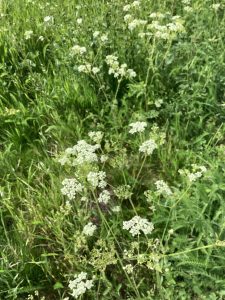 During June and July, confusion reigns and one may be forgiven for using the word ‘Umbellifer’ as a generic term meaning ‘a plant that may or may not be Cow Parsley’. The two commonest infiltrators into our hedgerows and roadside verges during these months are Rough Chervil and Upright Hedge- parsley, each growing to a similar height to that of their neighbouring Cow Parsley. The newer arrivals are (like Esau, brother of Jacob) hairy ones, and a feel of the leaves might be enough to distinguish them from Cow Parsley. But the key identifier between these 3 species is the stem of the plant: the stem of Rough Chervil is purple spotted as well as hairy, that of Cow Parsley is smooth and green, and that of Upright Hedge-parse is hairy but unspotted.
All these Umbellifers are members of the Carrot family. As an alternative in June to walking our hedgerows feeling leaves and mimicking Isaac in trying to distinguish between relative hairiness (after all, Isaac famously got it wrong), one may consider roaming the Heyshott Down reserve at the top of Chalky seeking to find Wild Carrot and then musing on the millennia of selective breeding which has led to our common vegetable. Wild Carrot itself is only locally common, favouring our chalk grassland. Its stem is shorter than that of our roadside Umbellifers, standing up to 75 cm tall, and its umbels perhaps justify the parasol description more, for they are closely packed together andwould more naturally be thought offer shelter from the rain to invertebrates.
Their charm is in their colour, for the flowers start pink in bud, turning to white but retaining in the crown one single red or purple centrepiece. And whilst looking, one might discover some Burnet-saxifrage, an Umbellifer of similar height to our Wild Carrot, but more delicate, its flowers frothier, its stem spindly and its leaves thin and modest, but with oval leaflets at the base of the plant
May 2026
‘O Nightingale that on yon bloomy spray
Warbl’st at eve, when all the woods are still…
Now timely sing, ere the rude bird of hate
Foretell my hopeless doom, in some grove now’
Milton’s Ode to a Nightingale is nowadays less well known than that of Keats, which is perhaps a shame. For the Keats poem, with its lament ‘Thou was not born for death, immortal Bird!’, ends presciently, and depressingly, with ‘Fled isnthat music’. Fled indeed it is from our part of the South Downs, and more and more restricted to its stronghold in East Sussex and Kent.
The Milton poem focuses on superstition, and in particular the bad luckpotentially faced by the lover who hears the ‘rude bird of fate’ before hearing the first Nightingale of the season. This rude bird of fate was the Cuckoo, a reference to the unpleasantries of its parasitic nature. A Cuckoo was heard on Heyshott Common on 21 April, and this would perhaps suggest that Heyshott lovers have a good deal of bad luck in store, this and every year.
But we can perhaps now put this old superstition safely in the ‘historic’ box and merely celebrate the return of a Cuckoo as a harbinger of Spring. Nowadays in Heyshott, the rude bird of fate is much more likely to be taken as a characterisation of one of our corvid species, and possibly of the largest one of all, the Raven.
 The fortunes of our Ravens have been the opposite of those of our Nightingales. The Sussex breeding population of Ravens became extinct in Sussex in the late 19th century, with occasional sightings between then and the 1990s probably being visitors from families hanging on on the Isle of Wight. But as persecution diminished in the late 20th century, Ravens returned to suitable habitat on our Downs. This year, in the same week of April as a Cuckoo was heard, a group of 16 Ravens was seen on and above Heyshott Down.
Ravens are early nesters and fledging is taking place earlier in the year, indeed as early as late April. But those fledglings will not be able to fly for a fortnight, so the group of 16 will likely comprise several adult family groups flying together, suggesting that larger groups still will be seen later in the year. As he population continues to grow, it is more than possible that Heyshott will become a location for communal winter roosts of Ravens, sited alongside those of its Jackdaws and Rooks.
There will be many who will lament that the celebrated song of the Nightingale has been replaced in Heyshott by the croak of the Raven. But visually, might the majestic sight of 16 soaring Ravens be more uplifting than a snatched sighting of a small brown bird warbling at eve, not from a bloomy spray, but from deep within a bramble thicket???
April 2026
There are said to be over 60 species of ant living in the UK. This is already too much information, for many are localised and many are introduced. Surveys on the Murray Downland Trust reserves have identified 10 species as present, and the species best known in our village will be the Black Garden Ant, thousands of which emerge on the wing in our gardens in mid summer.
However, the best identifiers for some of the oldest grassland in Heyshott are the anthills of colonies of Yellow Meadow Ants. Some of these anthills are centuries old. Yet the ants themselves are seldom seen, rarely appearing above ground.
These ants are a closely related species to our familiar garden ants. Their dining habits are similar also, with a penchant for the honeydew produced by aphids which they are able to ‘farm’ for the purpose. In winter they may eat the aphids themselves. They forage below the surface and if one is seen above ground, it is usually a queen seeking a new nest site.
This underground foraging leads to the creation of nests which are pushed up and then dot across suitable grassland. This activity creates what could be considered as a separate habitat from the surrounding thicker grasses. The hillock tops are dryer, and this enables smaller flora such as wild thyme to survive with less completion from the thicker grasses elsewhere. This can attract specialist invertebrates, such as the Chalk Hill Blue butterfly, a late flying butterfly seen on Heyshott Escarpment in mid to late summer and reliant upon Horse Shoe Vetch and some other low growing members of the pea family as foodstuff for its larvae.
The hillocks also attract rabbits for use as latrines, perhaps indirectly further enhancing the localised flora. The grass covering to the anthills provides the ants with a degree of protection from predators. But predators there are, both mining bees and wasps and also our misnamed Green Woodpeckers, better known for their searching for ants on the ground than for their wood pecking and better named by their onomatopoeic ‘Yaffle’.
When it comes to defence, the meadow ants have no sting. For this reason they are often recommended as a suitable ant to keep as pets in order to study the operation of a colony. But this is somewhat simplistic, for the absence of a sting is made up for the presence of a bite which is supplemented by the production of formic acid. The combination is by nomeans pleasant, and if an emergent colony is disturbed by an enthusiastic gardener they are best left alone.
March 2026
The incessant rain which has dominated the year to date will it seems continue into March, further restricting the activities of work parties on Heyshott Scarp and dampening many of our New Year ambitions. But the rain indicates mildness and that mildness will have assisted many of our songbirds in surviving the winter. Dartford Warbler numbers on the heaths should show an increase this year, and the breeding success of our commonest songbirds is already being indicated by the volume of early February birdsong – particularly that of Robins, Wrens, Song Thrushes and Greenfinches – around the village.
Our January and February weather will be missed by our migrant birds but will still have an impact on them insofar as it will have affected the emergence of the invertebrates on which they need to feed both themselves and their young. The timing of the migrants’ arrivals will depend upon the weather patterns in, and the wind direction from, countries to the south of us in the coming months. But what might we typically expect to see and hear in Heyshott in March?
The earliest of our warblers to arrive back to our village will usually be Chiffchaffs and Blackcaps, returning from their wintering grounds in West Africa. By the third week of March, there should be regular sightings of each in Heyshott (early Blackcaps favour our Mistletoe) and the song of each should be commonplace by the end of the month. But the migrating patterns of each of these species are changing – more of our Chiffchaffs and Blackcaps are remaining in the UK as mild winters become the norm, and some Blackcaps are now migrating from mainland Europe to the UK for the winter and leaving the UK as our regular migrants return.
 Our Garden Warblers and Grasshopper Warblers typically overwinter further south in West Africa and arrive somewhat later than our Chiffchaffs and Blackcaps. They are shyer birds, rarely seen on their migration which in all likelihood will be shrouded by the night, but a Garden Warbler – distinguished rather by its plainness and the absence of distinguishing features – has been seen in Heyshott as early as the third week of March. Our hedge loving Whitethroats typically arrive in April but one or two may be scraping out their song in the hedgerows by the end of March.
Our Tree Pipits winter further south in woodland in sub-Saharan West Africaand our Barn Swallows travel even further into South Africa. Our breeding pipits and swallows are unlikely to arrive as soon as March, but Heyshott is a stopping point for birds travelling further north and we should expect to see swallows in the village before the month is out. We will then feel with confidence that Spring has truly arrived even if the formal advice is ‘ne’er to cast a clout for another couple of months.
January- February 2026
A member of the Murray Downland Trust made a gift to the Trust at its annual talk in November in the Cobden Hall. The gift was of 6 Elm saplings, for planting on the MDT’s reserves. The donor, Dr Richard Smith, is a retired arboriculturalist and an expert in the provenance of surviving Elms in the United Kingdom. It is of course well known that virtually all mature Elms in the UK died in or after the 1970s following their infestation with a disease that became known as Dutch Elm disease. The disease is a fungus spread by a bark beetle. Smaller Elms survive within hedgerows – indeed, there are many in Heyshott – but these would fall victim to the disease if allowed to grow to their full height.
There are two species of Elm which are generally considered native to the UK, the English Elm and the Wych Elm. Both are susceptible to Dutch Elm disease, which was named after the country in which it was originated rather than a particular species which it might attack. The English Elm bears little if no resistance, and this is now thought to be because of its lack of genetic diversity – all specimens are now thought to descend from one individual introduced to the UK in Roman times (making the term English Elm a probable misnomer and casting doubt on the designation as ‘native’), with reproduction being by suckering rather than  seed production. Wych Elm does produce seed which has led to a degree of genetic diversity enabling some mature specimens to survive attack. But mature English Elms can only survive by avoiding attack in the first place; pockets of individuals still hang on in Kent and East Sussex where the spread of disease is limited by the treeless features of the eastern end of our South Downs.
The taxonomy of Elms is however by no means straightforward. There are up to 30 species of Elm north of the Equator, half a dozen of which are European. Eighteenth century gardeners revelled in hybridisation; one well known hybrid is the Chichester Elm, named after Chichester Hall in Essex but with a legitimate West Sussex connection as Chichester Hall was at one point owned by the then Bishop of Chichester. The Elms donated to the MDT are hybrids, deriving from a mature specimen which appears to be thriving in Cocking.
This complexity creates a challenge for the MDT. The clay soils within the Heyshott reserves would potentially provide a suitable home for hybrid Elms,but it would be a curious choice for a grassland conservation charity to seek to plant hybrid specimens within an SSSI even if Natural England were to permit this. So it is likely that the saplings will leave Heyshott, and will probably find a home in the Trust’s newest reserve at Hurston Warren where there is a mosaic of habitat to manage outside the heathland SSSI.
December 2025
Keen arachnophiles will have spotted a story reported by the BBC and the Times that a species of spider last seen on the UK in the 1980s has been rediscovered at the same site on the Isle of Wight. This spider is known as the White-knuckled Wolf Spider and is the only UK species of the genus ‘Aulonia’.
It is however only distinguishable from a species of a different genus (one of the so-called ‘Otter Spiders’) by the white patella of its pedipalp (i.e. it has white dots on the kneecaps of its forward appendages). The spider is approximately 4 mm long and was found on part of a National Trust reserve only accessible by boat; the story perhaps typifies the single mindedness needed to be a spider recorder.
One of the two ‘finders’, Graeme Lyons, is known to many in Heyshott. He has carried out invertebrate and fauna surveys on the Heyshott reserves of the Murray Downland Trust and has given talks on his survey results in the Cobden Hall. Unfortunately for Heyshott, Graeme now regards the rediscovery of this wolf spider on the Island as the likely highlight of his career, but that is not to say that the population of spiders at Heyshott is other than remarkable.
The Murray Downland Trust first commissioned a survey of the spider populations on Heyshott Escarpment and Heyshott Down in 2008. 101 different species were identified, covering an enormous range of crab spiders, jumping spiders, wolf spiders, and web weavers, including trapdoor weavers and some woodlice specialists and ant specialists. There seems however to be one common feature, which is that spiders, whatever their mode of collecting their prey, are opportunist ‘wait and see’ predators. Unlike many insects, spiders are not generally associated with particular plants; they are usually generalist predators and, from a management perspective, ospiders will thrive the more abundant and varied the insect population on which they feed. The wider the variety of flora, the greater the availability of insects and the healthier the populations of spiders will be.
Graeme’s latest survey in 2022 covered all the Murray Downland Trust reserves and identified 119 different species of spider. 17 of these species had ‘conservation status’, but Graeme’s work across Sussex and beyond has shown that many of these ‘statuses’ are often out of date or misleading – many species which are described as Nationally Scarce can be locally common. But some are clearly not, and two Heyshott examples in particularwere exciting finds:
• Araneus alsine , known as the strawberry spider,  is restricted to bogs in northern Scotland and limited areas in southern England; it is an orb web spider spinning webs with a closed hubs in low vegetation. Its specked orangey coloration is highly distinctive and justifies its common name.
• Phaeocedus braccatus is a rare ground spider generally only found on chalk grassland in just a few areas in the South of England. It is the only UK species in its genus and, unlike most ground spiders, is diurnal. At first sight it resembles and moves like an ant, but no ant has such a distinctive patterning of three pairs of white spots on its abdomen.
November 2025
The results of the 2025 Wealden Heaths Breeding Bird Survey were published in September, narrowly beating the publication by the Sussex Ornithological Society’s Sussex Bird Report for 2024, demonstrating the speed of distribution of on-line results over hard copy publications which we now take for granted.
The heathland survey covers 10 Wealden Heaths including Heyshott and Ambersham Commons and focuses on 5 priority species, those of Nightjar, Woodlark, Dartford Warbler, Tree Pipit and Stonechat. Once again the survey shows that Heyshott and Ambersham have the largest number of Nightjar territories, with 19 out of the 77 territories across the heaths. This population of Nightjars appears stable year on year and so there is every expectation of the return of our birds next Spring. The mean arrival date in Sussex is 8 May and dusk walks next June can be expected to be rewarded with churring birds.
A story less often told is that Heyshott and Ambersham Commons also hold the greatest population of Dartford Warblers across the heaths, with a total of 10 breeding territories. Dartford Warblers are a bell weather species in the UK; they are primarily birds of the Iberian Peninsula and the southern Mediterranean, and southern England is at the extreme northern end of their range. Unlike our Nightjars, they do not migrate and are are therefore very exposed to harsh winters; they experienced a severe population crash in 2010 and 2011, since when their numbers have steadily increased and can be expected to increase further as our mean temperatures continue to rise.
They are distinctive warblers, easily identified by their long slender tails and grey heads and their quick rattling warble; they can produce up to 3 broods between April and July, nesting low down in the gorse or the heather. Heyshott and Ambersham Commons do not top the table for the other 3 target species, although the small numbers of Woodlark and Stonechat appear stable. Tree Pipit is the only one of the target species where numbers have declined significantly across Sussex in recent years, and the survey indicates that there were only 2 breeding territories of Tree Pipit in our local common this year (Woolbeding Common topped the table with 7 territories). This is intriguing, for it indicates that the population of Tree Pipits on the relatively small reserve on the top of Heyshott Down is now greater than that across our local heathland. Are these different families, or has thepopulation moved to a habitat which might be more suitable? It has not proved possible to graze Heyshott Down in 2025 owing to local TB concerns, but its grassland has been mechanically cut on rotation and the presence of isolated tall trees for song posts and display appears particularly suited to our red listed Tree Pipits. The Murray Downland Trust is already eagerly anticipating their return next April.